Some people find gentle breathing exercises calming or helpful for focusing their attention. You can try the exercises below and see whether any feel useful to you. There is no need to force your breathing or use a technique that feels uncomfortable. NHS guidance also recommends breathing gently and only as deeply as feels comfortable. NHS breathing exercises
A note before you begin
These exercises are optional self-care ideas. They may not suit everyone, and they do not treat FND or replace your personalised rehabilitation plan. If an exercise makes you feel dizzy, breathless, uncomfortable or more symptomatic, stop and let your breathing return to its usual rhythm. You can also ask a health professional who knows your situation whether a particular exercise is suitable for you.
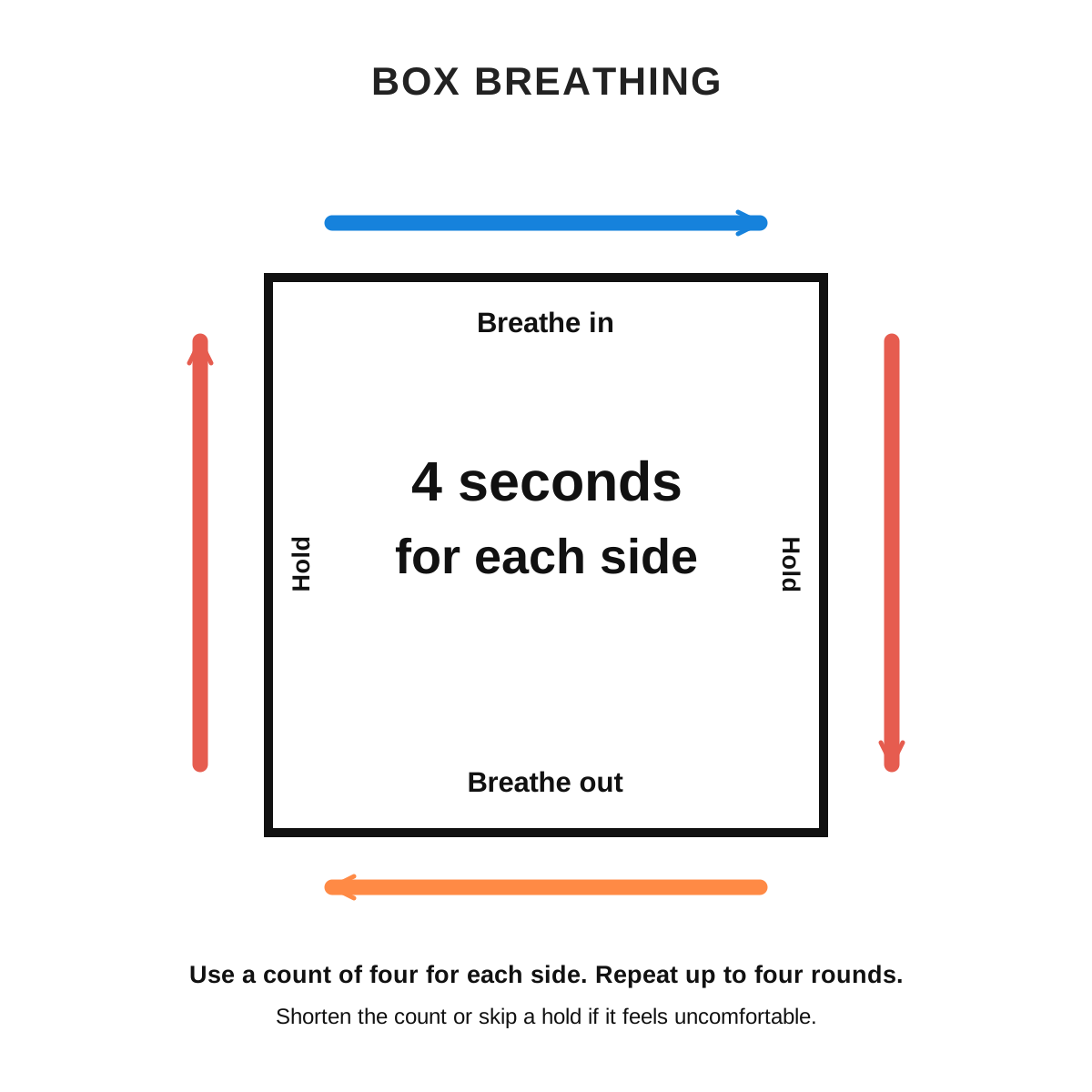
Box breathing
Box breathing, sometimes called square breathing, uses four equal parts: breathing in, holding, breathing out and holding again.
-
Breathe in gently through your nose for a count of four.
-
Hold your breath for a count of four, if comfortable.
-
Breathe out gently through your mouth for a count of four.
-
Hold for a count of four, if comfortable.
-
Repeat the sequence up to four times.
You could try this twice a day if it feels comfortable. The counts are a guide, not a target: shorten them or leave out the breath holds if needed.
Physiological sigh
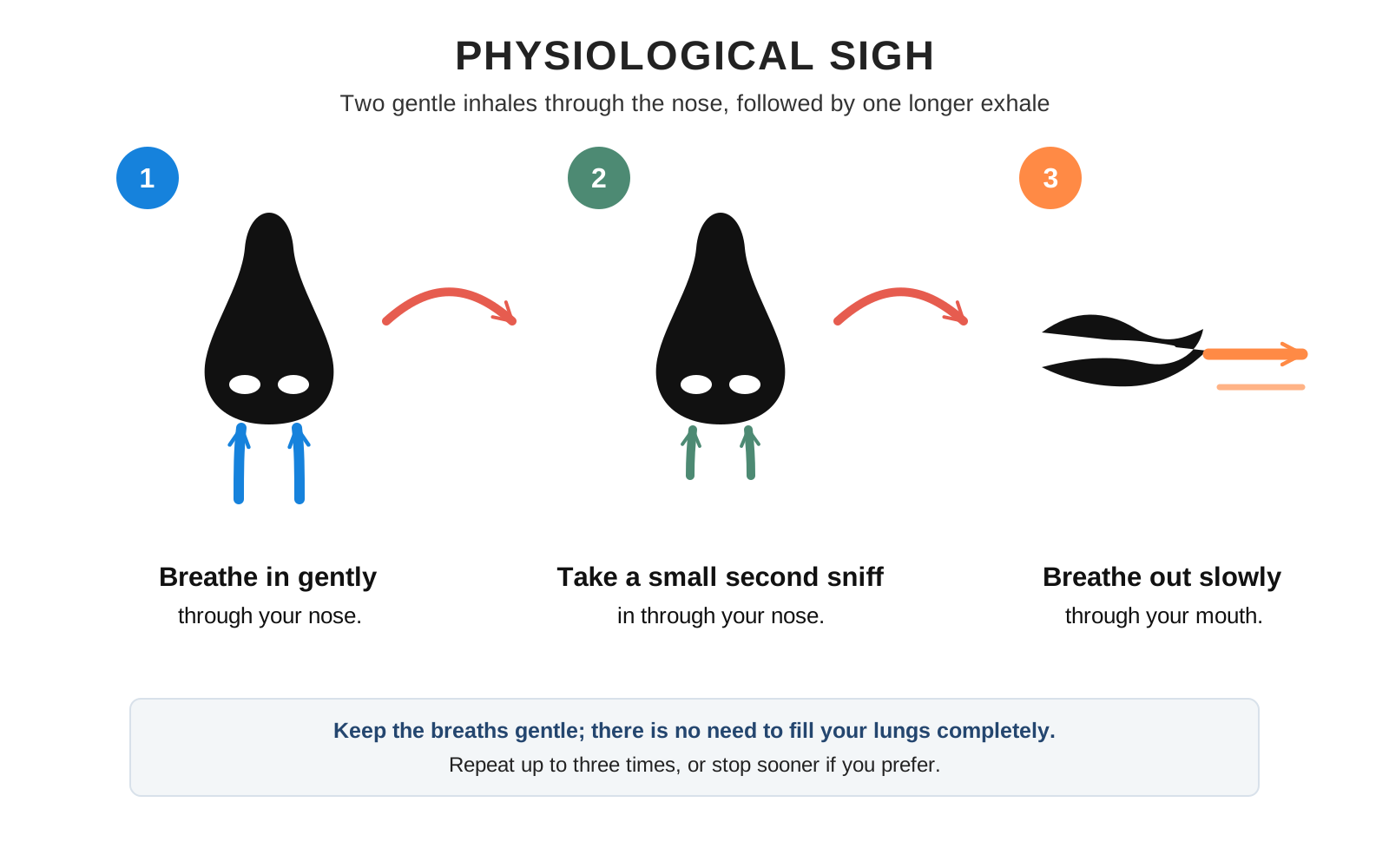
The breathing pattern of one gentle inhale, a second small inhale, followed by a longer exhale is often called a physiological sigh or cyclic sighing. Stanford Medicine describes this pattern as two inhales through the nose followed by a slow exhale through the mouth. Stanford Medicine
-
Breathe in gently through your nose.
-
Before breathing out, take a second, smaller sniff in through your nose.
-
Breathe out slowly through your mouth.
-
Repeat up to three times, or stop sooner if you prefer.
Keep the breaths gentle rather than trying to fill your lungs completely.
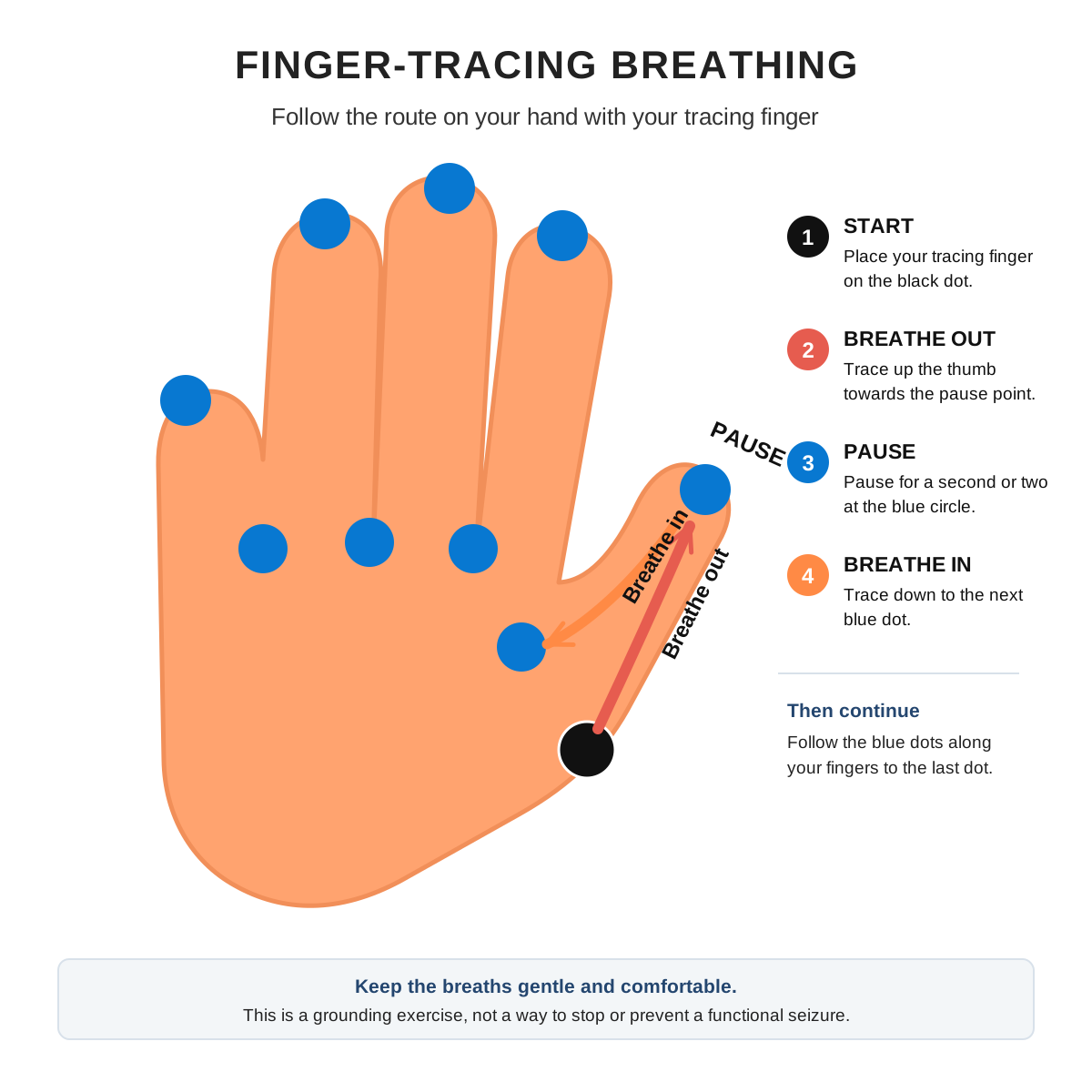
Finger-tracing breathing
Some people may find it helpful to pair gentle breathing with tracing a finger along their hand. You can use this as a grounding exercise; it is not a proven way to stop or prevent a functional seizure.
-
Rest one hand comfortably with your fingers open. Place a finger from your other hand on the black dot.
-
As you breathe out gently, trace up the side of your thumb.
-
Pause briefly at the “PAUSE” circle, only if that feels comfortable.
-
As you breathe in gently, trace down the other side of your thumb to the next blue circle.
-
Continue tracing and breathing along your fingers until you reach the last blue dot.
You can pause or stop at any time. If you have functional seizures, follow the advice and plan agreed with your health professionals. A small pilot study has explored a specific breathing-control programme delivered by a respiratory physiotherapist, but that research does not establish that this finger-tracing exercise treats functional seizures. Pilot study on breathing-control training